Unlike Any Other: Why We Return to Augusta Every April
By Cameron Pratt, E-Commerce & Marketing Manager / Northway Golf Center
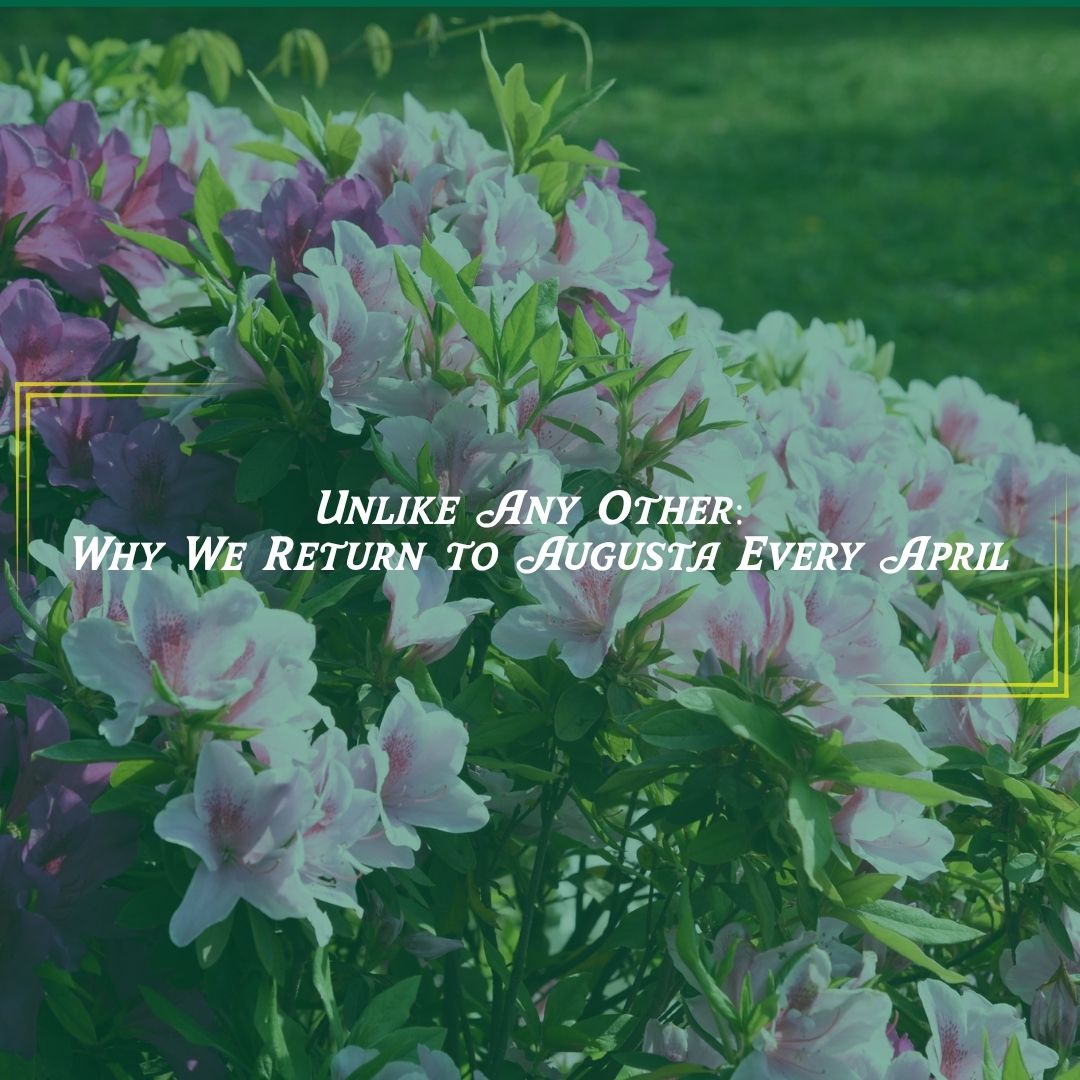
Growing up in the Green Mountains of Vermont, I'm no stranger to the quiet times of the wilderness. The soft chirps of a Hermit Thrush or a squirrel bounding through sticks is the soundtrack to most any outdoor adventure, including on the golf course. Alas, courses today have not the bloom that occurs every Spring at Augusta National, complete with the solemn haze of misty morns and the pristine Georgia sun and shade that bathes that course from dawn 'till dusk.
Well, such is what I think of when I see it on television, at least.
Indeed, like many I have not had the privilege to travel to Georgia for the greatest event in golf. My taste buds have not found purchase of pimento cheese and egg salad sandwiches, nor have my nostrils been afforded the chance to breath in the azaleas. I am, such as it is, an observer.
And yet, every April my eyes are tuned in to the event. There's a pageantry in the lack thereof—it's the simplicity of it all, paired with such precision of every manicured green and bunker that invites a sense of "otherness" from all other events.
It's sacred. A memento to bygone ages of quiet and peace that golf has to some degree... evolved beyond. While we all yearn for an escape from the devices that we find inside our pockets, the modern game has adapted to them and "golf-influencer" has become a new norm on our digital airwaves.
Perhaps then, it is a most necessary reminder of the harmony we ought to cherish when we allow ourselves to sit back, breathe, and remember why we love the game.
It is a picture of "perfect", to be sure. What we (I) would give to play on such a course. Sure, we all have our favorites (shoutout to Lake St. Catherine Country Club). But the ability of all to have grounds kept to the degree that is the standard of Augusta? It is a dream of a thought.
"Perfect", though, is still subjective. Novel, even. That's why we flock back every year, is it not? The Masters gives us a minimal supply, which in turn generates massive demand. Just to set foot on the course as a fan (sorry, patron) is a lifelong ambition fulfilled for some. Without hyperbole, it is a Mecca of Golf, and that deserves reverence.
Is it all just economics? Well, yeah.
At the same time, it is all the more important to remember that the history of Augusta, and golf itself, has blemishes. It would be shortsighted to not acknowledge that exclusion by race and gender at the club was not finally overturned until the years 1990 and 2012, respectively. A product of times long past, indeed.
Perhaps, too, it is late to harp on such things in 2026, but if golf is to be for all, then upholding those values also means that there has to be some rectification of the exclusionary nature that has often permeated this sport—if but only by the willingness to say a collective "we must do better."
With all that in consideration, it begs the question of where Augusta National, and The Masters itself, lives in the contemporary state of the Game. To be sure, there is no greater height in golf than winning the Green Jacket. It is a pinnacle to be sought, well, unlike any other. And as the date rolls over into April, the thaw accompanies it… and something shifts.
Not just in the weather, though that helps. The ground softens, the air carries a bit more life, and the range starts to sound like something again. There’s a reawakening that happens this time of year that feels tied to the Masters whether we admit it or not. The game, in a sense, comes back online—but not in the way we’ve come to expect from everything else in our lives.
If anything, Augusta slows it down.
It’s strange, really. The most watched event in golf, and yet it feels the least chaotic. There’s no rush to it. Everything takes a breath. (Quite literally, I'll never forget Jim Nantz not saying a word for nigh on three minutes after Tiger Woods' "Return to Glory" in 2019). You notice things you normally wouldn’t: the way a ball lands softer than expected, the way a player pauses just a beat longer over a putt, the way the gallery seems to move as one organism rather than a collection of individuals chasing a better vantage point.
That’s not accidental.
Augusta has always been deliberate. From the way it presents itself to the way it controls access, it exists just slightly outside the norms of everything else in the sport. And whether that’s by design, tradition, or a bit of both, it creates something that feels… preserved.
Not untouched. But preserved. A symphony of timing, coordination, and well-kempt grounds that truly boggles the mind when you stop to think about it.
I mean, they use ice-packs and heaters to make sure the azaleas bloom at the right time!
Because golf, broadly speaking, is not preserved. It’s evolving—sometimes for the better, sometimes just because it has to. Technology pushes distance further. Content pushes personality forward. Courses adapt, brands adapt, players adapt. There’s a constant sense that the game is trying to keep up with itself.
Augusta doesn’t really do that.
It adjusts, sure. It lengthens when it needs to. It modernizes in ways that are most necessary. But it does so without losing the essence of what it wants to be. And in doing that, it becomes less about competing with the modern game and more about existing alongside it as a sort of... an anchor point. A reminder of the solitude we seek when we tee up for ourselves.
You can watch a full season of golf and see all the variations: the different grasses, the varied styles of play, the shifting atmospheres. And then April comes around and everything funnels back through one place that says, in its own way, “this is still golf, too.”
And maybe that’s why it resonates the way it does.
Because it doesn’t try to outdo everything else. It doesn’t need to. It just needs to be itself—serenely, confidently, and without apology.
That doesn’t mean it’s above criticism. It shouldn’t be. No institution should be. The history matters. The barriers that existed—and in some ways still exist—matter. Access, cost, culture… those conversations are ongoing, and they should be. If the game is going to grow in a meaningful way, it has to continue opening its doors wider than they’ve historically been.
But acknowledging that doesn’t take away from what the Masters represents in the present. If anything, it adds weight to it.
Because now it isn’t just a symbol of tradition—it’s also a reflection of how tradition can evolve, slowly and imperfectly, but forward nonetheless.
And through all of that, the core of it remains intact.
The walk up 18.
The hush before impact.
The roar that rolls through the trees when something improbable happens.
You don’t need to have been there to feel it. That’s the strange part. For most of us, it exists entirely through a screen, filtered and framed and carefully presented. And yet, it still lands. It still feels different.
Maybe that’s the magic of it. Or maybe it’s just consistency, done so well that it feels like the arcane. Either way, it works.
Because year after year, we come back to it. Not just to see who wins, but to sit in it for a while. To let the game slow down. To remember what it looks like when everything is aligned with intention.
And then, inevitably, it ends.
The Green Jacket is awarded, and the Sunday Golden Hour fades over the horizon. Come Monday morning, the rest of the golf world starts moving again at its usual pace. The next Major; the next product release; the next unfortunate photo or incident of a player captured by the media. Yet... something lingers.
A feeling, maybe. Or just a standard that’s been quietly reset.
Not that every course should be Augusta, or that every event should try to replicate it. That would miss the point entirely. But that there is still value in restraint. In care. In letting the game exist without constantly needing to be more than it is.
And so we go back to our own courses. To the uneven lies and imperfect greens. To the rounds that don’t quite come together. To the mulligans, the novelties, and the realities of playing the game where we actually are.
For a brief stretch each April, we’re reminded of what it can feel like at its most distilled. Not perfect, but close enough to make you pause.
Close enough to make you think.
And more than anything, close enough to bring you back again next year.
Back to an event that is, indeed, unlike any other.
About the author:
Cameron Pratt has been on the Northway staff since September of 2025, where his duties extend to all things digital content. Having played golf periodically since his high school days, Cameron finds himself in the "game improvement" category of golfers. Enjoying the social and competitive aspect of the game, his appreciation lies in the both the quiet and comradery brought about by the sport. A native Vermonter, he carries a deep love for the Green Mountains and Adirondacks alike and prefers to play on mountain-terrain courses.
Powered by Lightspeed
Display prices in:USD